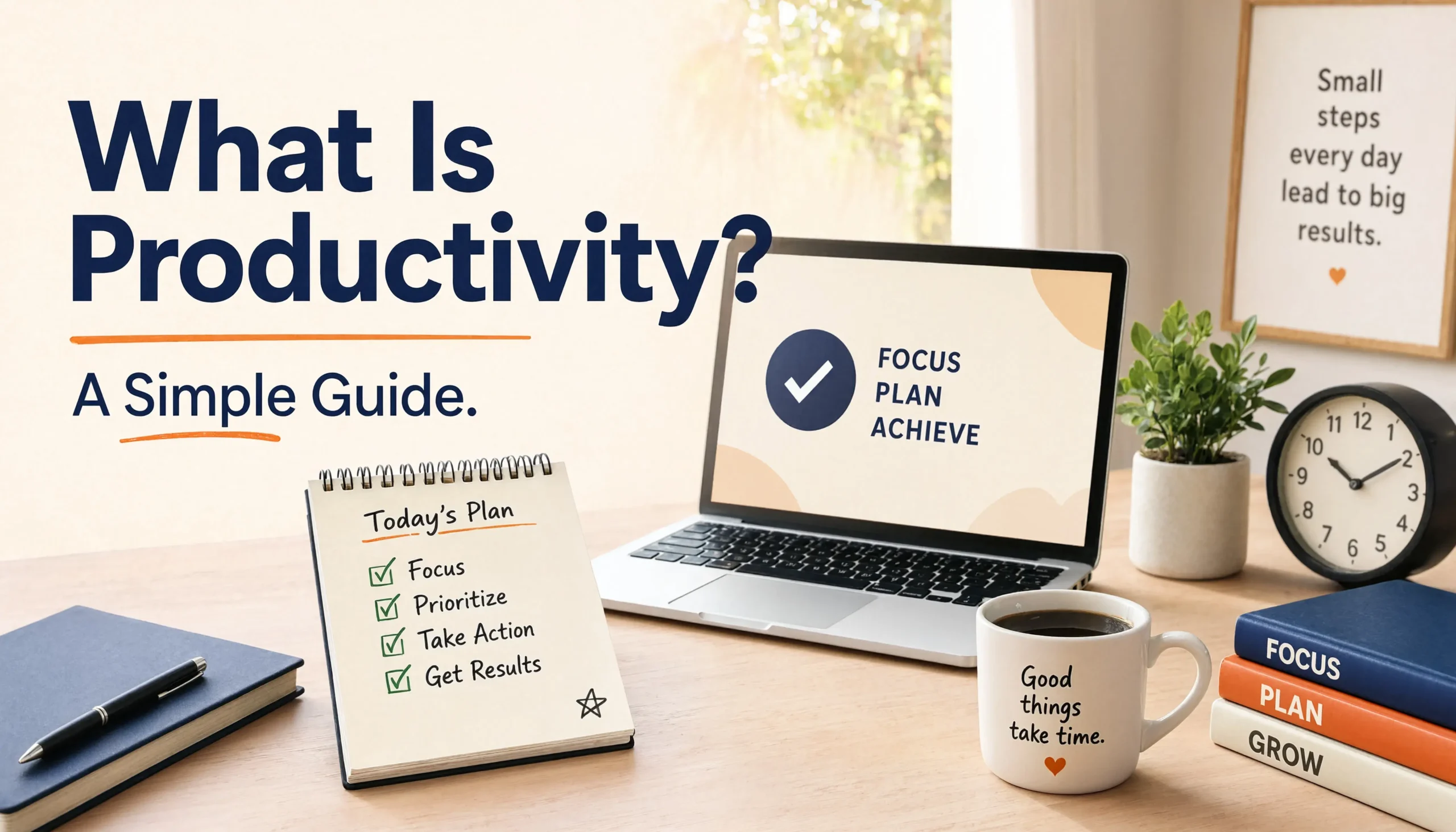
What Is Productivity? A Simple Guide
What Is Productivity? A Simple Guide to Working Better
If you have ever wondered what is productivity, the simple answer is this: productivity is about how effectively you use your time, energy, attention, and resources to achieve a useful result. It is not simply about doing more work. A productive person may complete fewer tasks than someone who is constantly busy, but achieve more meaningful results. Good productivity is about working with purpose, managing priorities, reducing wasted effort, and making steady progress towards your goals.
What Is Productivity?
Productivity is the relationship between the useful output you produce and the resources you use to produce it.
In everyday life, those resources can include:
- Time
- Energy
- Attention
- Money
- Tools
- Skills
- Information
- Other people’s time
For example, imagine two people spend two hours writing a report. One person spends most of the time switching between emails, social media and messages, then finishes half the report. The other blocks out two focused hours and completes the report with fewer interruptions. Both spent the same amount of time, but their useful output was different. That is where productivity becomes important.
Productivity Does Not Mean Staying Busy
One of the most common misunderstandings about productivity is that being busy automatically means being productive. It does not. You can spend an entire day answering unnecessary emails, attending meetings that do not require you, reorganising folders, or repeatedly checking notifications. You may feel busy at the end of the day without making meaningful progress.
Productivity asks a different question:
Did the work you did actually move you closer to your goal?
Busy vs Productive
| Busy behaviour | Productive behaviour |
|---|---|
| Checking notifications constantly | Checking messages at planned times |
| Starting many tasks | Focusing on important tasks |
| Working without priorities | Following a clear task list |
| Attending every meeting | Joining meetings where your input is needed |
| Multitasking constantly | Focusing on one task at a time |
| Working longer by default | Improving how work is organised |
The goal is not to eliminate activity. The goal is to make your effort more useful.
Why Is Productivity Important?
Good productivity can make work and daily responsibilities easier to manage.
It Helps You Reach Goals
Large goals can feel difficult when they are treated as one huge task. Breaking a goal into smaller actions makes it easier to start and track progress.
For example:
Goal: Start a blog
Instead of simply writing “start a blog” on your task list, you could divide it into:
- Choose a topic.
- Select a website platform.
- Choose a domain name.
- Set up the website.
- Create the main pages.
- Write the first article.
- Publish and review it.
The goal stays the same, but the next action becomes much clearer.
It Reduces Wasted Time
Productivity can help you identify activities that consume time without providing much value. For example, if you spend several minutes checking your phone every time a notification appears, those interruptions can break your concentration. Reducing unnecessary interruptions can make focused work easier.
It Helps You Manage Priorities
Not every task has the same importance. A productive approach means deciding what needs attention first rather than simply working through tasks in the order they appear.
It Can Reduce Unnecessary Stress
When everything is kept in your head, it can be difficult to remember what needs to happen next. A simple task list, calendar or planning system can give you a clearer picture of your responsibilities.
What Are the Main Types of Productivity?
Productivity applies to more than office work.
Personal Productivity
Personal productivity is about managing your own time, attention and responsibilities.
Examples include:
- Planning your day
- Organising household tasks
- Managing appointments
- Building useful habits
- Making time for important goals
Workplace Productivity
Workplace productivity focuses on producing useful results efficiently.
Examples include:
- Completing projects
- Managing meetings
- Writing reports
- Responding to important communication
- Collaborating with colleagues
Team Productivity
Team productivity involves helping a group work effectively together. Clear communication, defined responsibilities and sensible processes can make it easier for people to work towards the same goal.
Digital Productivity
Digital productivity involves using computers, apps and online tools effectively.
Examples include:
- Calendar applications
- Task-management apps
- Note-taking tools
- Document software
- Communication platforms
- Automation tools
Technology can support productivity, but using more apps does not automatically make someone more productive.
How Do You Measure Productivity?
Productivity can be measured in different ways depending on the type of work.
A simple concept is:
Productivity = Useful output ÷ Resources used
For example, a person might compare how many completed tasks they produce during a certain amount of focused work. However, productivity is not always about counting things. A customer-service employee, teacher, designer or researcher may produce valuable work that cannot be fairly measured by simply counting completed tasks. Quality matters too.
Common Productivity Measures
Depending on the situation, you might look at:
- Completed tasks
- Project progress
- Time required for a task
- Quality of the finished work
- Accuracy
- Customer satisfaction
- Deadlines met
- Errors reduced
- Goals achieved
The right measurement depends on the type of work being done.
How to Become More Productive
You do not need a complicated productivity system to get started. Try these practical steps.
Choose Your Most Important Tasks
At the beginning of the day, identify the tasks that matter most. Instead of creating a list of 20 priorities, decide which few tasks genuinely need your attention.
Break Large Tasks Into Smaller Steps
“Finish the project” can feel overwhelming.
“Write the introduction” or “review the first section” is much easier to act on.
Smaller actions reduce the mental barrier to getting started.
Remove Obvious Distractions
Put your phone away when you need uninterrupted concentration. Close unnecessary browser tabs and silence non-essential notifications. You do not have to remove every distraction permanently. The goal is to create a better environment for focused work.
Work in Focused Sessions
Instead of trying to concentrate for several hours without a break, divide your work into manageable periods.
For example:
- 30–45 minutes of focused work
- Short break
- Another focused session
- Longer break when appropriate
You can adjust the length to suit your work and concentration.
Avoid Unnecessary Multitasking
Switching between tasks can make work feel active, but frequent task switching can make it harder to maintain concentration. When possible, finish or reach a useful stopping point on one task before moving to another.
Use Tools Carefully
A calendar can help with appointments. A task manager can help you remember responsibilities. A notes app can help organise information. Automation can reduce repetitive work. But tools should simplify your workflow rather than create another layer of work.
Review Your Day
At the end of the day, take a few minutes to ask:
- What did I complete?
- What still needs attention?
- What caused unnecessary delays?
- What should I prioritise tomorrow?
- Is there anything I can simplify?
This turns productivity into an ongoing improvement process.
Productivity Tips for Everyday Life
You can improve productivity without completely changing your lifestyle.
Try these simple habits:
- Write down important tasks instead of relying on memory.
- Start with one clear task.
- Keep frequently used items organised.
- Turn off unnecessary notifications.
- Group similar tasks together.
- Set realistic deadlines.
- Leave some space in your schedule for unexpected work.
- Take proper breaks.
- Keep your workspace comfortable.
- Review unfinished tasks rather than carrying them mentally all day.
- Protect time for important work.
- Learn to say no to tasks that are not necessary when appropriate.
Productivity Tools: Do You Need Them?
Productivity tools can be useful, but there is no single tool that works for everyone. A simple notebook may be enough for one person. Another person may prefer a digital task manager, calendar, project-management system or note-taking application.
The important question is not:
“Which productivity app should I use?”
It is:
“What problem am I trying to solve?”
For example:
| Problem | Possible solution |
|---|---|
| Forgetting appointments | Calendar |
| Forgetting tasks | Task list |
| Losing notes | Note-taking system |
| Repeating the same digital task | Automation |
| Difficulty managing projects | Project-management tool |
| Too many notifications | Notification controls |
Choose the simplest solution that solves the problem.
Productivity and Work-Life Balance
Productivity should not mean working every available hour. Constantly trying to increase output can eventually leave less time for sleep, relationships, hobbies and recovery. Rest is also part of maintaining sustainable performance. A productive routine should therefore consider the whole person, not just the amount of work completed. The goal is not to turn every minute into a work opportunity. It is to use your available resources thoughtfully.
Common Productivity Mistakes
Trying to Do Everything
A huge task list can create pressure rather than clarity. Prioritise what genuinely matters.
Copying Someone Else’s Routine
A productivity method that works for another person may not fit your schedule, responsibilities or working style. Experiment and adapt.
Using Too Many Apps
Constantly switching between productivity tools can become its own distraction. Start with the basics.
Ignoring Breaks
Working continuously is not necessarily the most effective approach. Short breaks can give you an opportunity to reset before continuing.
Measuring Only Speed
Completing a task quickly is not useful if the result is inaccurate or needs extensive correction. Consider quality as well as quantity.
A Simple Productivity System for Beginners
If you are new to productivity planning, try this basic system.
Write Everything Down
Create one list of the tasks you need to remember.
Choose Your Priorities
Identify the tasks that are important or time-sensitive.
Pick the Next Action
Turn each major task into a clear, physical action.
Instead of:
“Work on website”
write:
“Write the homepage introduction.”
Schedule Important Work
Give important tasks a realistic time slot when possible.
Focus
Work on the selected task without unnecessary interruptions.
Review
At the end of the day, check what was completed and move unfinished tasks forward. This simple approach is enough to start building better productivity habits.
Productivity FAQs
What is productivity in simple words?
Productivity means using your available time, energy and resources effectively to produce useful results and make progress towards your goals.
Is productivity the same as working faster?
No. Speed is only one part of productivity. Quality, accuracy, priorities, efficiency and the value of the result also matter.
How can I improve my productivity?
Start by identifying your most important tasks, breaking large tasks into smaller steps, reducing distractions and reviewing your progress regularly.
What is personal productivity?
Personal productivity is the way you manage your time, attention, energy and responsibilities to achieve your personal goals.
Do productivity apps really help?
They can help with specific problems such as organising tasks, managing schedules or storing information. However, an app alone does not create good productivity habits.
Can productivity help reduce stress?
A clear system for organising tasks and priorities can make responsibilities easier to manage. However, productivity should not mean constantly working or trying to eliminate every moment of rest.
Conclusion
So, what is productivity? It is more than being busy or completing as many tasks as possible. Productivity is about using your time, attention, energy and resources in a purposeful way to produce useful results. Start small. Choose clear priorities, remove unnecessary distractions, break large tasks into manageable steps and review what works for you. The best productivity system is one that helps you make meaningful progress without making everyday life unnecessarily complicated.