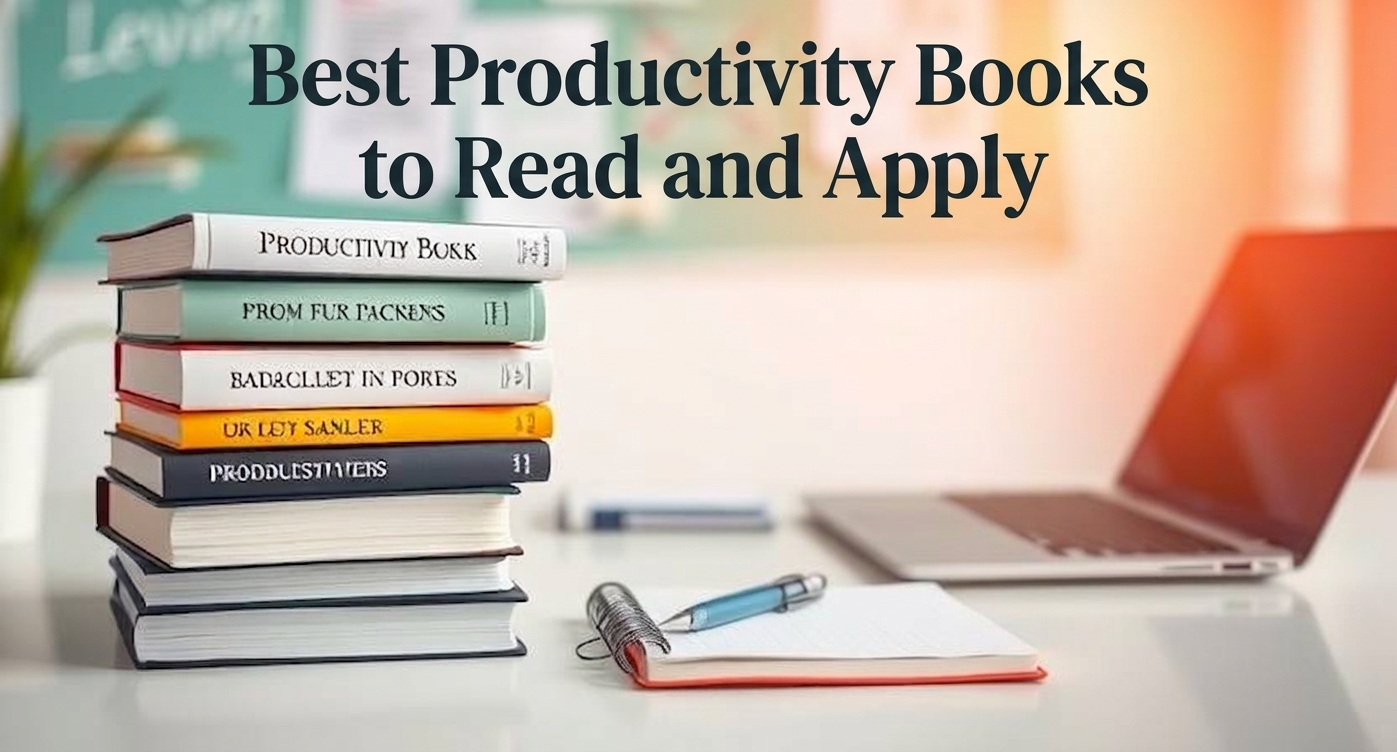
Best Productivity Books to Read and Apply
If you want to improve your focus, manage your time better, build useful habits, or stop feeling overwhelmed by your daily tasks, the best productivity books can give you practical systems to try. The right book can help you understand why you procrastinate, how habits form, how to prioritise important work, and how to create routines that actually fit your life. However, productivity is not about doing more every minute. It is about making better decisions about what deserves your time and attention.
Best Productivity Books to Read
Here are some widely recognised productivity books, each with a different approach:
| Book | Author | Best For |
|---|---|---|
| Atomic Habits | James Clear | Building better habits |
| Deep Work | Cal Newport | Improving focus |
| Getting Things Done | David Allen | Organising tasks |
| The 7 Habits of Highly Effective People | Stephen R. Covey | Personal effectiveness |
| Essentialism | Greg McKeown | Doing fewer things better |
| The One Thing | Gary Keller and Jay Papasan | Prioritising important work |
| Four Thousand Weeks | Oliver Burkeman | Rethinking time and productivity |
| Make Time | Jake Knapp and John Zeratsky | Designing a more focused day |
These books are not identical. Some focus on habits, while others deal with attention, planning, priorities, or the limits of time.
Atomic Habits by James Clear
Atomic Habits focuses on how small, consistent changes can develop into lasting habits.
James Clear presents a framework for making good habits easier to start and bad habits harder to maintain. The book is especially useful if you repeatedly create productivity plans but struggle to follow them.
Practical takeaway
Instead of setting a vague goal such as:
“I want to become more productive.”
Create a specific behaviour:
“After breakfast, I will spend 20 minutes working on my most important task.”
The idea is to make the desired behaviour clear and easy to repeat.
Best for: Habit building, routines, consistency and personal improvement.
Deep Work by Cal Newport
Deep Work explores the value of focused work without constant interruptions. The book is particularly relevant for people who spend much of their day switching between email, messaging apps, social media, meetings and other distractions.
Practical takeaway
Try creating a daily period when you work on one demanding task without unnecessary notifications.
For example:
- Choose one important task.
- Put your phone away.
- Close unrelated browser tabs.
- Turn off non-essential notifications.
- Work for a defined period.
- Take a break before starting another task.
Best for: Students, writers, developers, researchers and anyone who needs sustained concentration.
Getting Things Done by David Allen
David Allen’s Getting Things Done introduces a structured approach to managing tasks and commitments. One of its central ideas is that your mind should not have to act as a storage system for every unfinished task.
A practical workflow can involve:
- Capturing things that need your attention.
- Clarifying what each item means.
- Organising tasks into appropriate lists.
- Reviewing those lists regularly.
- Taking the next appropriate action.
This approach can be useful when you have too many tasks competing for your attention.
Best for: Task management, project organisation and reducing mental clutter.
The 7 Habits of Highly Effective People by Stephen R. Covey
Stephen R. Covey’s The 7 Habits of Highly Effective People takes a broader approach to effectiveness. Rather than focusing only on productivity techniques, it discusses principles, priorities, relationships and personal responsibility. The book can be useful if you want to think about productivity beyond simply completing more tasks.
Best for: Personal effectiveness, priorities, leadership and long-term development.
Essentialism by Greg McKeown
Essentialism focuses on identifying what is genuinely important and reducing unnecessary commitments. This is an important productivity lesson because a crowded schedule does not automatically mean meaningful progress. For example, instead of trying to complete ten low-priority tasks, you might identify the two or three activities that have the greatest importance and protect time for them.
Best for: Prioritisation, simplifying schedules and avoiding unnecessary commitments.
The One Thing by Gary Keller and Jay Papasan
The One Thing centres on the idea of identifying the most important task or priority and giving it focused attention. This approach can be useful when your to-do list keeps growing and you are unsure where to start.
A simple daily question is:
What is the most important thing I can work on today?
Once you identify it, schedule time for it rather than waiting until the end of the day.
Best for: Prioritisation and avoiding scattered attention.
Four Thousand Weeks by Oliver Burkeman
Four Thousand Weeks takes a different approach to productivity. Rather than promising that you can fit everything into your schedule, the book examines the reality that human time is limited. This perspective can be useful for people who constantly feel behind despite using planners, calendars and productivity apps. The practical lesson is to make deliberate choices about what you will not do as well as what you will do.
Best for: Time management, priorities and developing a healthier perspective on productivity.
Make Time by Jake Knapp and John Zeratsky
Make Time presents practical ideas for creating more space for what matters during an ordinary day. Its approach includes experimenting with daily priorities, reducing distractions and designing your environment to support attention. Rather than treating productivity as a rigid system, it encourages experimentation. For example, you could choose one daily highlight and protect time for it before dealing with less important activities.
Best for: Everyday productivity, attention management and practical experiments.
How to Choose the Right Productivity Book
The best productivity book for you depends on the problem you are trying to solve.
If you struggle with habits
Start with Atomic Habits.
It is a useful choice if you want to build consistent routines or make small behavioural changes.
If distractions are your biggest problem
Consider Deep Work.
It is particularly relevant if notifications, social media and constant task switching make concentrated work difficult.
If you have too many tasks
Getting Things Done may be more useful.
Its focus on capturing and organising commitments can help create a clearer external system.
If you say yes to too many things
Try Essentialism.
It encourages you to examine whether a commitment is genuinely important before giving it your time.
If you constantly feel short of time
Four Thousand Weeks offers a different perspective.
Instead of promising perfect time management, it encourages you to accept limitations and make deliberate choices.
How to Get More From a Productivity Book
Reading an entire productivity library is not necessarily productive.
Instead, try this simple approach.
Choose one problem
Identify the issue you want to solve.
It could be:
- Procrastination
- Poor focus
- Too many tasks
- Inconsistent habits
- Digital distractions
- Poor prioritisation
Pick one book
Choose the book that most closely matches that problem.
You do not need to read several productivity books at the same time.
Take useful notes
Write down ideas that could realistically change your behaviour.
Avoid copying every interesting concept.
Test one idea
Turn one lesson into an experiment.
For example:
Problem: Constant phone interruptions
Experiment: Keep the phone outside the workspace during a 45-minute focus session.
Review the result
After several days, ask:
- Did this help?
- Was it easy to maintain?
- What got in the way?
- What should I change?
This turns reading into practical learning.
Productivity Books vs Productivity Apps
Books and apps solve different problems.
A book can help you understand how and why to change your behaviour. An app can help you put that system into practice.
For example, you might learn about prioritisation from a book and then use:
- A calendar for time blocking
- A task manager for action lists
- A notes app for capturing ideas
- A focus timer for concentrated sessions
- A habit tracker for recurring behaviours
The technology is useful only when it supports a system you can actually maintain.
A Simple Productivity System to Try
You can combine ideas from several productivity approaches without adopting an entire system.
Try this:
Every morning:
- Choose one major priority.
- Write down the next action.
- Schedule focused time for it.
- Silence unnecessary notifications.
- Keep a short list of secondary tasks.
At the end of the day:
- Check what you completed.
- Move unfinished tasks to an appropriate place.
- Choose tomorrow’s main priority.
- Stop working when your planned work is finished.
The goal is not to create a complicated productivity machine. It is to make important work easier to start and easier to finish.
FAQs About the Best Productivity Books
What is the best productivity book for beginners?
Atomic Habits is a practical starting point for readers interested in building better routines. If your main issue is organisation rather than habits, Getting Things Done may be a better fit.
Which productivity book is best for focus?
Deep Work focuses heavily on sustained concentration and reducing distractions during demanding work.
Are productivity books actually useful?
They can be useful when their ideas are turned into practical experiments. Simply reading several books without changing your behaviour is unlikely to produce much improvement.
Should I read several productivity books?
You can, but it is often more useful to read one book, test its ideas and decide what works before moving to another.
Which productivity book is best for time management?
There is no single answer for everyone. Getting Things Done focuses on organising commitments, while Four Thousand Weeks approaches time from the perspective of limited time and deliberate prioritisation.
Conclusion
The best productivity books are not necessarily the ones with the most complicated systems. The most useful book is usually the one that addresses the specific problem you are facing. If you want better habits, start with Atomic Habits. For focused work, consider Deep Work. For organising commitments, explore Getting Things Done. If your main challenge is deciding what deserves your attention, Essentialism and The One Thing offer different approaches. The key is to read less passively and experiment more. Choose one useful idea, apply it to your daily life, and keep what genuinely helps.