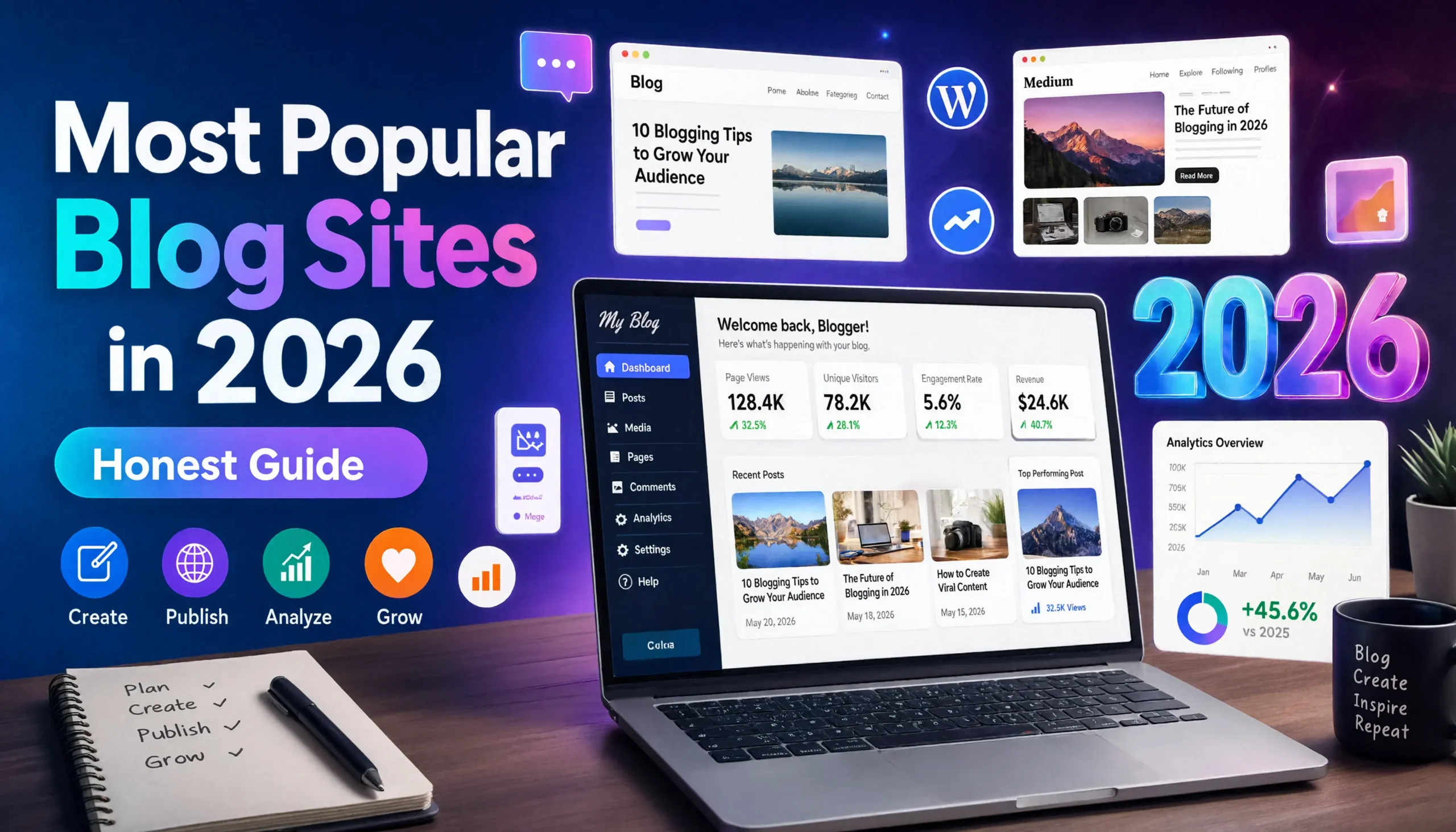
Most Popular Blog Sites in 2026 (Honest Guide)
Most Popular Blog Sites in 2026: Which Platform Should You Use?
If you want to start a blog, the platform you pick matters more than most people realize. The right one makes writing, growing, and monetizing your content far easier. The wrong one wastes your time or limits what you can do.
So, which blog sites are the most popular right now — and which one is actually right for you?
This guide breaks it all down clearly.
Why Your Choice of Blog Platform Matters
There are over 600 million blogs on the internet today, and they collectively publish around 7.5 million new posts every day. That is a massive amount of content competing for attention. Your platform affects how your blog looks, how fast it loads, how well it ranks in Google, and whether you can earn money from it. Picking the wrong platform early on means migrating later — which is painful and time-consuming.
The Most Popular Blog Sites in 2026
Here is a look at the platforms that dominate the blogging world right now, who they are best for, and what you need to know before choosing one.
WordPress.org (Self-Hosted WordPress)
Best for: Serious bloggers, businesses, content marketers
WordPress.org is the most widely used blogging and content management system in the world. It powers over 522 million websites globally. Unlike WordPress.com (its hosted sibling), WordPress.org gives you complete ownership and control over your site. You install it on your own hosting server, choose from thousands of free and paid themes, and extend functionality with a massive plugin library. Plugins cover everything from SEO tools to e-commerce, contact forms, and analytics.
Pros:
- Full control over your site’s design and function
- Unmatched plugin and theme ecosystem
- Strong SEO capabilities out of the box
- No revenue share or platform fees
- Scales from a personal blog to a full business site
Cons:
- Requires a hosting plan (usually $3–$15/month to start)
- Some technical setup involved
- You handle your own backups and security
Bottom line: If you are serious about blogging long-term, WordPress.org is the gold standard. The learning curve is mild with good hosting providers, and you own everything.
WordPress.com (Hosted)
Best for: Beginners who want a simple, managed setup
WordPress.com is the hosted, managed version of WordPress. You do not need to deal with hosting or technical setup. It handles security, backups, and updates for you.
The free plan gives you a basic blog on a WordPress.com subdomain. Paid plans unlock custom domains, more storage, and advanced features.
Pros:
- Zero setup — just sign up and write
- Free plan available
- Reliable uptime and security managed for you
Cons:
- Less control than self-hosted WordPress
- Monetization and customization are limited on lower plans
- Your site lives on their platform, not your own server
Bottom line: Good for beginners testing the waters, but you will likely outgrow the free plan quickly.
Blogger (by Google)
Best for: Hobbyists and casual writers who want completely free hosting
Blogger is one of the oldest blogging platforms still active today. It is free, hosted by Google, and requires zero technical knowledge.
It holds a significant share of the blogging market globally — and an even larger slice in some countries — largely because it has been around since 1999 and costs nothing to use.
Pros:
- Completely free, including hosting
- Backed by Google’s reliable infrastructure
- Simple to set up and use
Cons:
- Limited design and customization options
- Minimal SEO and plugin support
- Google has shown little interest in developing it further
Bottom line: A reasonable choice if you just want to write casually and spend nothing. Not ideal if you want to grow a serious audience or earn income.
Medium
Best for: Writers who want a built-in audience and clean writing experience
Medium is a popular publishing platform that doubles as a content discovery engine. You write, and Medium’s algorithm can surface your content to its existing readership. This makes it appealing for writers who want exposure without worrying about SEO or site design. Medium has a Partner Program that pays writers based on how much time paying members spend reading their content.
Pros:
- Beautiful, distraction-free writing experience
- Built-in audience and content discovery
- No setup needed — just start writing
Cons:
- You do not own your audience or content platform
- Monetization depends entirely on Medium’s rules
- Limited customization and branding
Bottom line: Great for getting your writing in front of readers quickly. Less ideal if building your own brand or business is the goal.
Substack
Best for: Writers building a newsletter and paid subscriber base
Substack has grown rapidly over recent years. It lets writers publish articles and newsletters, build a subscriber list, and charge for access to premium content. The platform received around 47.6 million unique website visitors in September 2025 alone — a massive jump year over year.
Substack is free to use, but takes 10% of paid subscription revenue (plus payment processing fees).
Pros:
- Very easy to get started
- Built-in email newsletter tools
- Built-in paid subscription model
- Growing, engaged community
Cons:
- Takes 10% of your paid revenue
- Weak SEO — not built to attract Google traffic
- Limited design and branding options
- You are building on someone else’s platform
Bottom line: Excellent for writers who want to monetize through email subscriptions. Not the best choice if search traffic is your primary growth channel.
Ghost
Best for: Independent creators, paid newsletters, professional publishers
Ghost launched in 2013 and has grown steadily into one of the most respected publishing platforms available. It combines blogging, newsletters, and paid memberships in a clean, fast interface. Ghost Pro (the hosted version) charges a monthly fee but takes 0% of your revenue. You can also self-host Ghost for complete control at no platform cost.
Pros:
- Built-in membership and newsletter tools
- No revenue share on paid plans
- Fast, clean, and SEO-optimized by default
- Modern markdown-based editor
- Open source (can be self-hosted)
Cons:
- Fewer themes and plugins than WordPress
- Requires some technical comfort if self-hosting
- Ghost Pro plans can get expensive at scale
Bottom line: One of the best options for professional writers who want to run a membership-based blog without giving up a cut of their earnings.
Wix
Best for: Creatives, small business owners, visual bloggers
Wix supports over 243 million websites worldwide. Its drag-and-drop builder makes it easy to create a visually polished blog without writing a line of code. In recent years, it has added AI-powered design and content tools that streamline setup further.
Pros:
- Very beginner-friendly drag-and-drop interface
- Hundreds of professional templates
- All-in-one: website + blog + basic e-commerce
- AI-assisted layout and content suggestions
Cons:
- Less flexible than open-source platforms
- Harder to migrate your content to another platform later
- Monthly costs can add up on higher plans
Bottom line: A solid pick for someone who values design and ease of use over deep technical control.
Squarespace
Best for: Designers, photographers, and creatives with a portfolio
Squarespace is known for its genuinely beautiful templates and polished design experience. If how your blog looks is a top priority, it delivers with minimal effort.
Pros:
- Elegant, responsive templates
- Clean all-in-one experience (blog + store + portfolio)
- Good built-in analytics and SEO tools
- Strong customer support
Cons:
- More expensive than most competitors
- No third-party plugins — you are limited to built-in features
- Not the strongest choice for long-form content-heavy blogs
Bottom line: Worth the price if aesthetics and visual presentation are central to your brand.
Quick Comparison Table
| Platform | Best For | Free Plan | Revenue Share | Owns Your Content |
|---|---|---|---|---|
| WordPress.org | Full control, serious blogs | No (hosting cost) | None | Yes |
| WordPress.com | Beginners, managed setup | Yes | None | Partial |
| Blogger | Hobby bloggers | Yes | None | Yes |
| Medium | Writers, built-in audience | Yes | Algorithm-based | No |
| Substack | Newsletter + paid subscriptions | Yes | 10% of paid subs | No |
| Ghost | Professional publishing | No (Ghost Pro) | 0% | Yes (if self-hosted) |
| Wix | Visual/creative bloggers | Yes (limited) | None | Yes |
| Squarespace | Creatives, portfolios | No | None | Yes |
How to Choose the Right Blog Platform for You
Ask yourself these questions before deciding:
Do you want full control over your blog? Go with WordPress.org. It is the most flexible option and you own everything.
Are you just starting out and want something free and simple? WordPress.com or Blogger works well to get your ideas published without any cost.
Do you want to grow a newsletter and charge for subscriptions? Ghost or Substack are both strong here. Ghost gives you more long-term flexibility and keeps 100% of revenue. Substack is easier to launch but takes a 10% cut.
Is design your top priority? Squarespace or Wix will serve you better than most alternatives.
Do you want exposure from a built-in audience without technical setup? Medium is the most straightforward option for pure writers.
Tips for Getting Started on Any Platform
- Buy a custom domain early. A domain like yourblog.com looks more professional than yourblog.wordpress.com or yourblog.blogspot.com.
- Start with fewer categories. New bloggers often spread too thin. Pick one or two topics and go deep.
- Publish consistently, even if imperfectly. A post every two weeks beats waiting months for a perfect one.
- Think about SEO from day one. Even a basic SEO plugin or platform feature can make a meaningful difference in how Google finds your content.
- Do not monetize too early. Build an audience first, then introduce ads, subscriptions, or affiliate content.
Frequently Asked Questions
Which is the most popular blogging platform overall?
WordPress is the most widely used blogging platform in the world. WordPress.org powers over 522 million websites, and WordPress.com holds the largest market share among dedicated blogging platforms globally.
Is Blogger still worth using in 2026?
Blogger still has a large user base because it is completely free and Google-hosted. However, it has seen very little product development in recent years. It is fine for casual hobby blogging, but not recommended if you plan to grow a serious readership or earn income.
Can I make money from a free blog platform?
It depends on the platform. Medium has a Partner Program, and Substack lets you charge subscribers on its free plan (with a revenue cut). On fully free platforms like Blogger, monetization options are limited. WordPress.org gives you the most freedom to monetize however you choose.
What is the easiest blogging platform for a complete beginner?
Blogger, WordPress.com, Substack, and Medium are all easy to start with — no technical knowledge required. Substack and Medium, in particular, let you start writing within minutes of signing up.
Is Substack better than WordPress for a newsletter?
For newsletters specifically, Substack is easier and faster to launch. But WordPress.org with a newsletter plugin (like Mailpoet or ConvertKit integration) gives you more long-term control and no revenue share. It depends on how much setup work you want to do upfront.
Should I start on Medium or build my own blog?
Both can work, but they serve different goals. Medium gives you immediate exposure to an existing audience. Your own blog (on WordPress, for example) gives you full ownership of your audience, brand, and revenue. For long-term brand building, your own blog usually wins.
Conclusion
The most popular blog site depends on what you need from it. WordPress.org dominates for good reason — it is flexible, powerful, and gives you full ownership. But it is not the only answer. Ghost is excellent for professional publishers. Substack works well for newsletter writers. Medium suits writers who want exposure fast. Think about your goals before you pick. Do you want control, or convenience? A built-in audience, or your own independent platform? Answer those questions, and the right choice becomes much clearer. Start simple, stay consistent, and you will find your footing no matter which platform you choose.