AI Detector How It Works & Which Tools to Trust
If you’ve submitted an assignment, published a blog post, or reviewed a freelancer’s work recently, there’s a good chance it’s been run through an AI detector.
These tools promise to tell you whether a piece of text was written by a human or generated by ChatGPT, Gemini, Claude, or similar AI models. But how accurate are they really, and should you trust the result?
This guide explains what an AI detector actually does, compares the tools people use most, and is upfront about where these tools get it wrong, because they do, more often than most people assume.
What Is an AI Detector?
An AI detector is a tool that analyses text (and increasingly images, audio, and video) to estimate the probability that it was generated by an AI system rather than written by a person.
These platforms are used by teachers, editors, writers, and anyone who wants to check whether content is human-authored or computer-generated, covering use cases from catching AI-written student essays to spotting bot-generated posts in online forums.
eweek
They don’t work like plagiarism checkers, which match text against existing sources. Instead, most AI detectors look at statistical patterns in the writing itself, things like word predictability, sentence rhythm, and structural consistency, that tend to differ between human and AI-generated text.
Search Intent Behind “AI Detector”
People searching for this term are usually looking for one of these:
A free or paid tool to check content before submitting or publishing it
Clarity on whether a specific detector (like GPTZero or Turnitin) is reliable
An explanation of how AI detectors work and why they sometimes flag human writing
The best AI detector for a specific job: academic, SEO content, or hiringThis article covers all four.
How AI Detectors Work
Different tools use different methods, but two techniques come up repeatedly:
Perplexity and burstiness analysis: measures how predictable the word choices are (AI text tends to be more uniform) and how much sentence length and structure vary (human writing tends to be “burstier,” mixing short and long sentences more randomly).
Trained classifiers: models trained on large sets of labelled human and AI text, which learn to recognise patterns associated with each. Originality.ai, for example, uses a classifier trained on one million human-labeled text samples.
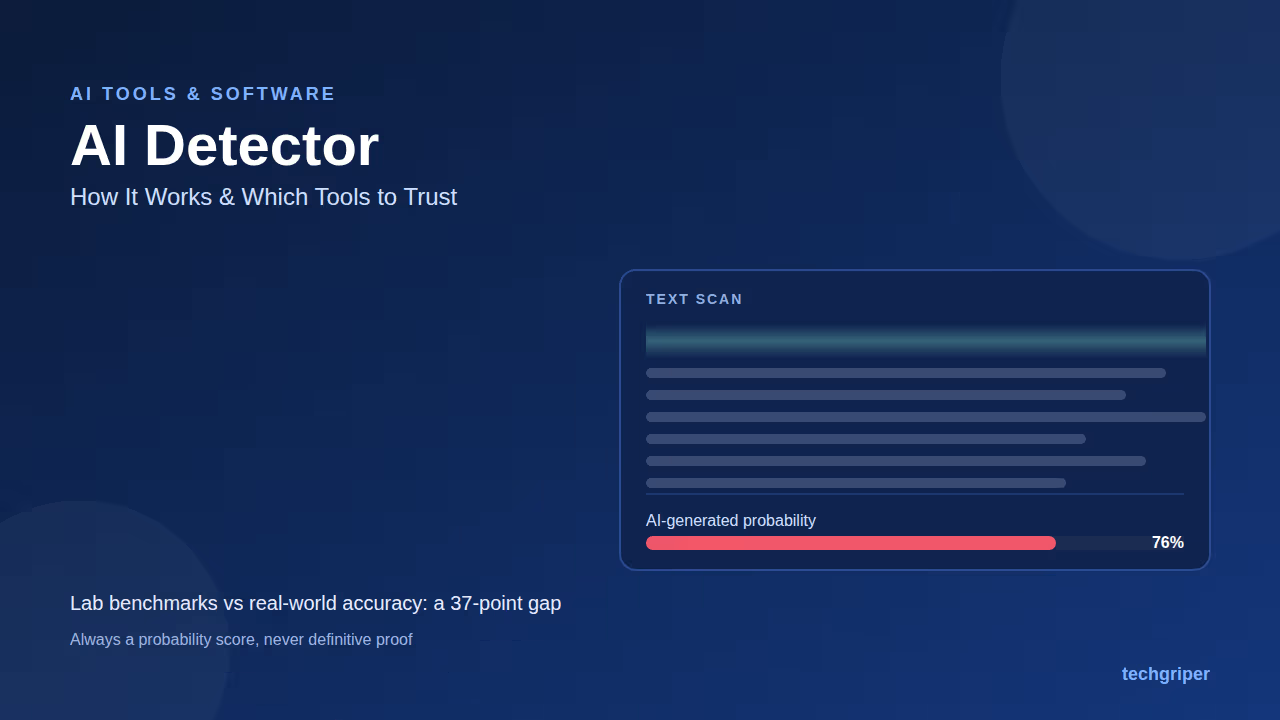
None of these methods produce a certain yes/no answer. Every detector outputs a probability score, not proof.
Popular AI Detector Tools Compared
GPTZero Educators and newsrooms Perplexity and burstiness analysis Yes, 10,000 words/month
Originality.ai SEO teams and publishers Classifier trained on labeled samples No, limited signup credits
Copyleaks Enterprise and multilingual checks Pattern-based classifier No
Turnitin Higher education institutions Transformer deep-learning classifier No, institutional access
Winston AI Classroom and professional use Sentence-level classifier 14-day trial
ZeroGPT Casual, low-stakes checks Heuristic analysis Yes, 15,000 characters/scanPricing and free-tier limits change often, so check each provider’s site for current numbers before choosing one.
A Closer Look at the Most-Used Options
GPTZero is widely used in education. It scored 99.5% accuracy in a January 2026 Chicago Booth benchmark that tested clean human writing against AI rewrites from GPT-4.1, Claude Opus 4, and Gemini 2.0 Flash. That’s a controlled-lab number, though, not a real-world guarantee (more on that below).
fast
Originality.ai is built more for publishers and SEO teams checking content at scale. One April 2026 independent benchmark placed it at 95.4% overall accuracy with a 1.8% false positive rate, the lowest among the major commercial detectors tested in that comparison.
It also bundles plagiarism and readability checks, which makes it useful for editorial teams rather than a one-off check.
Turnitin is mostly locked to institutions rather than individual users, since it’s aimed at higher education and uses a transformer-based deep-learning classifier, and most students encounter it
only through their university’s existing subscription.
checkthatZeroGPT is a reasonable starting point if you just want a free, no-signup check, though free tools generally trade some accuracy for accessibility.
How Accurate Are AI Detectors, Really?
This is the part most comparison articles gloss over. Accuracy numbers look strong in vendor and lab tests, but drop noticeably once text has been edited, paraphrased, or written by a non-native English speaker.
Independent benchmarks in 2026 found average AI detector accuracy around 85.7% on unmodified AI text, but accuracy dropped 15 to 30 percentage points once that same text was lightly paraphrased or human-edited.
fast
One detector that scored 99.5% in a controlled benchmark dropped to a real-world range of 62% to 88% depending on content type, according to independent testing by Kinja in March 2026.
fast
That gap matters. A tool that’s “99% accurate” on paper can still be wrong on a meaningful share of real submissions, especially content that’s been AI-assisted and then edited by a human, which is extremely common now.
Why AI Detectors Give False Positives
A false positive is when a detector flags genuinely human-written text as AI-generated. This tends to happen more often with:
Text written by non-native English speakers, since predictable sentence patterns can resemble AI output
Short pieces of text, where there isn’t enough content for the model to analyse reliably
Writing that’s naturally repetitive or list-heavy, like technical documentation
Because of this, no detector result should be treated as final proof, particularly in situations with real consequences, like a student facing academic discipline.
Pros and Cons of Using an AI Detector
Pros Cons
Useful first-pass check for editors and educators Not reliable as standalone proof of AI use
Can catch obvious, unedited AI output effectively Accuracy drops sharply on edited or paraphrased text Many tools offer free or low-cost tiers False positives can unfairly flag human writers
Some bundle plagiarism and readability checks Detection methods lag behind newer AI models
Useful for auditing large volumes of content Results vary significantly between tools on the same text
How to Use an AI Detector Responsibly
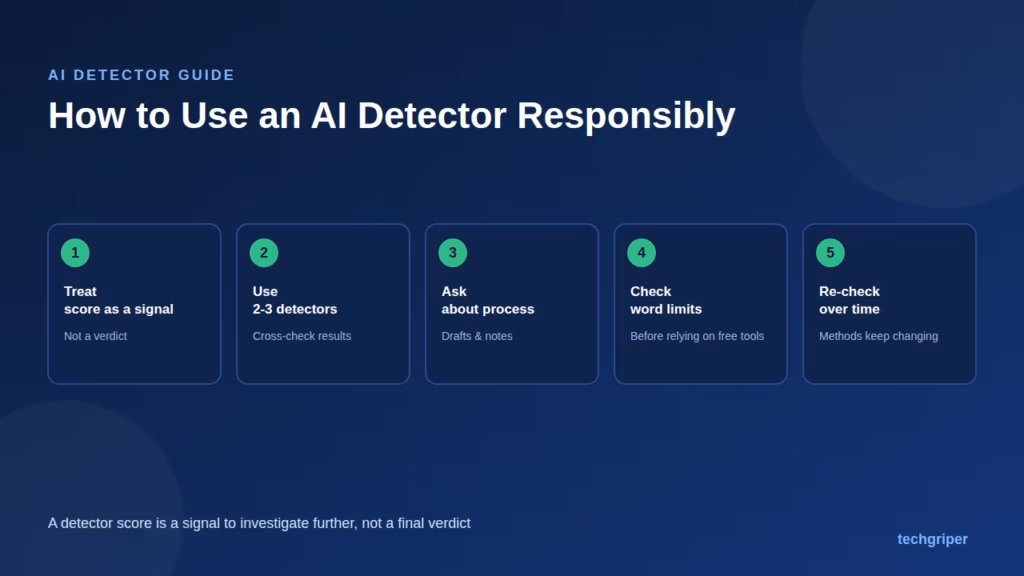
If you’re a teacher, editor, or hiring manager relying on these tools, a few practices help avoid unfair outcomes:
Treat the score as a signal, not a verdict. Use it to flag content for a closer look, not to make a final decision on its own.
Run text through more than one detector if the stakes are high. Since accuracy varies by tool and content type, agreement across two or three tools is more meaningful than one score.
Ask for the writing process, not just the output. Draft history, research notes, or a short conversation about the content can clarify intent better than a percentage score.
Check the free-tier word limits before relying on them. GPTZero offers 10,000 words a month free, while ZeroGPT allows 15,000 characters per scan, which may not be enough for longer documents.
checkthat
Re-check periodically. Detection methods and AI writing models both keep changing, so a tool’s accuracy today isn’t fixed.
AI Detector Use Cases in India
AI detectors are increasingly used across a few common situations in India:Students and educators, checking assignments and essays, especially at universities that don’t yet have institutional access to tools like Turnitin
Content agencies and freelance platforms, verifying that submitted articles meet a client’s originality requirements
Publishers and SEO teams, auditing existing content libraries for AI-generated pages that may need editing or disclosure
Recruiters, occasionally screening written test submissions or portfolio piecesFor most individual users, a free tool like GPTZero or ZeroGPT is enough for a quick check. Teams handling higher volumes or needing lower false-positive rates tend to lean toward paid tools like Originality.ai or Copyleaks.
FAQ
Can AI detectors be 100% accurate?
No. Even the highest-scoring tools in controlled benchmarks show reduced accuracy on real-world, edited, or paraphrased text. Treat results as probability estimates, not certainties.
Can I fool an AI detector?
Paraphrasing, editing, or mixing AI-generated content with human writing can lower detection accuracy, which is part of why real-world results are less reliable than lab benchmarks.
Do AI detectors work on languages other than English?
Accuracy varies by language and tool. Some platforms, like Copyleaks, are built with multilingual detection in mind, but performance is generally strongest on English text.
Is Turnitin’s AI detector available to individual users?
Typically no. Turnitin is aimed at higher education institutions and is usually accessed through a university’s existing subscription rather than sold directly to individuals.
checkthat
What’s the best free AI detector?
GPTZero and ZeroGPT both offer usable free tiers, making them reasonable starting points for casual or low-stakes checks.
checkthat
Should a single AI detector result be used to fail a student or reject a job applicant?
Given the documented false positive rates and the accuracy gap between lab and real-world conditions, relying on one tool’s score alone is risky. Most responsible use involves it as one input among several, not a final decision.
Conclusion
An AI detector can be a genuinely useful first check, whether you’re an educator screening assignments, a publisher auditing content, or a writer verifying your own work before submission.
But the accuracy numbers vendors advertise are usually lab conditions, not real-world performance, and every major tool shows a meaningful drop once text is edited or paraphrased.
Use these tools as one signal among several, cross-check high-stakes decisions with more than one detector, and avoid treating any single score as definitive proof either way.